Un anno fa il Giappone veniva funestato dal terremoto che tutti ricordiamo e che speriamo di non dover più vedere (o subire).
Il terremoto di Sendai e del Tōhoku del 2011 (in giapponese: 東北地方太平洋沖地震, Tōhoku chihō taiheiyō-oki jishin, letteralmente "Terremoto in alto mare della regione di Tōhoku e dell'Oceano Pacifico") si è verificato l'11 marzo 2011 al largo della costa della regione di Tōhoku, nel Giappone settentrionale, alle ore 14:45:23 locali alla profondità di 30 km. Il sisma ha avuto magnitudo 9,0 (secondo l'USGS)con epicentro in mare e con successivo tsunami. È stato il più potente sisma mai misurato in Giappone ed il quarto di sempre.
Luke Jerram ha creato una serie di sculture che rappresentano in 3D le onde devastanti del terremoto del Giappone, con la tecnica di rapid prototyping in plastica e anche in vetro, vedi
L'artista giapponese Katsumi Hayakawa realizza queste stupefacenti sculture in carta tridimensionali, molto complesse e dettagliate.
Qui sotto le opere che sono state in mostra lo scorso anno alla galleria MoMo di Roppongi. Le sue opere di carta realizzate nel 2011 le trovate qui.
Sul sito del quotidiano la Repubblica, questo video che mostra com'era questa spiaggia prima dell'11 marzo, durante lo tsunami e la totale distruzione della costa di Minanisoma, nel nord del Giappone, dopo il passaggio della terrificante onda post terremoto
Come aiutare il Giappone e il suo splendido popolo
Croce Rossa Italiana clicca qui
Nel modulo specificare in alto PRO EMERGENZA GIAPPONE e dona on line con carte Visa, Mastercard, American Express e con PayPal.
Dona per sms alla Croce Rossa Italiana 2 euro inviando un messaggio al numero 45500da qualsiasi cellulare (TIM, Vodafone, Wind, 3) o da telefono fisso.
Save the Children clicca qui I bambini sono sempre i più indifesi e meritano la nostra generosità, per donare compilare il modulo
(Preferendo chi devolve il 100% del prezzo al Global Giving per il Giappne)
Queste le collane e gli orecchini altered art che ho messo in asta io per le quali sarà devoluto l'intero importo dell'asta, un gioiello per voi e un aiuto concreto al Giappone:
Everywhere I turn, I'm seeing more and more artists responding to the disaster in Japan. It's incredibly heartwarming amidst such tragedy. My inbox is filling up with individuals sending out their info, and I would like to do a post here. If you are doing something similar and wish to add yourself to this list, please do so by leaving a comment here in the comments section. Here is what I am aware of so far:
Alicia Bock is giving proceeds from the photographs in this collection to the Red Cross for relief efforts in Japan.
Pinecone Camp is offering 50% off for the month of March on all sales in her etsy shop to the Red Cross.
The Working Proof and Susan Schwake has teamed up to produce a print where proceeds will go to Médecins Sans Frontières. via Pikaland
Tinyshowcase is raising money via The Rising Sun — a print by by Jesse LeDoux viaPikaland
The students at a local University here (UBC), have created a few ways to raise money. One I particularily love is they are selling paper origami cranes to raise funds. I love the legend that promises anyone who folds a thousand origami cranes will be granted a wish by a crane, such as long life or recovery from illness or injury. Lets hope this legend helps those in need now. Click here for more information on all the ways to help (a comprehensive list).
Check out Handmade for Japan who's mission is to raise money through an online auction on March 24-27 for relief efforts.
Hello Sandwich is selling the PDF of her Hello Sandwich Gift Wrapping for $5 and all money raised will go to the Red Cross to support survivors and rebuild Japan. Clickhere for info, here to view the PDF and here to buy (it's super cute)!. You can also donate through her friends' raffles here and here.
Ez from Wren and Chickadee (Creature Comforts) is currently donating 100% of their profits to help the relief efforts in Japan. Click here for more info.
Samantha Hahn has made a watercolor cherry blossom print to benefit Doctors Without Borders who are currently helping people in need during this crisis in Japan. Click here to see.
HEARTS + HANDS is a community effort organized by Lynn Russell of Satsuma Press. In 48 hours, fifty independent artists and studios have agreed to donate prizes for the raffle – and that list is still growing. Raffle tickets are for sale now at www.heartsandhandsforjapan.blogspot.com for $10 each. 100% of the proceeds from the HEARTS + HANDS raffle will be donated to relief efforts in Japan in the aftermath of the March 11th earthquake and tsunami.
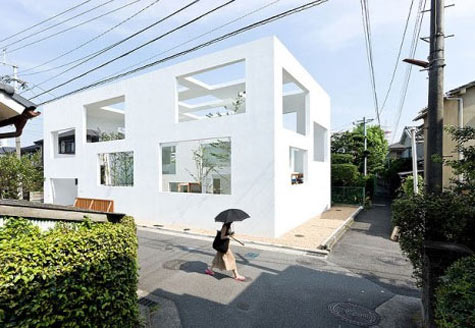
Il Giappone continua a far parte delle mie giornate. Nei telegiornali seguo con apprensione i tentativi per contenere il disastro nucleare e con tristezza guardo le macerie lasciate dalle onde apocalittiche. Sul web trovo invece gioie per gli occhi, come questa casa annidata nel sud del Giappone, a Oita, progettata dal geniale architetto Sou Fujimoto. La trovo bellissima, ma non potrei mai vivere (nonostante il nome della casa) in tanto minimal con tutto quello che accumulo senza mai buttare... per non parlare del perliname...
House N
Su ArchDaily moltissime foto per scoprire come è fatta.
Su DesignBoom invece un'interessante intervista all'architetto, le foto di altri suoi affascinanti progetti, come la casa a spirale e quella di tronchi, sui temi cari a Fujimoto del nido e della caverna
"I think I we have to be very serious about the change in climate and the situation of nature. I think that it is a great opportunity for us to rethink about the modern age culture of controlling everything. We have to change that kind of whole super controlling situation.for example air conditioning - when we use it we close and shut out nature and we are limited in the space we have. the artificial machine of the air conditioning is controlling our space and separating each other. Instead we might be able to live together and use a kind of natural power to create a more comfortable space. Humans should adapt a bit more, rather than control." S. Fujimoto
Ho trovato questa applicazione di Google Earth (vedi) dai colori vibranti, che mostra la devastante potenza delle onde del maremoto che ha distrutto intere città del Giappone l'11 marzo 2011.
2011-03-11 La massima ampiezza prevista per lo Tsunami
Lo tsunami Honshu è stato generato da un terremoto di Mw 8.9 (38.322°N, 142.369°E ), alle 05:46 UTC, a 130 km (80 miglia) ad est di Sendai, Honshu, Giappone (secondo l'USGS). Dopo circa 3 ore lo tsunami è stato registrato alla boa DART® 32412. I risultati previsti sono stati elaborato con il metodo di previsioni NOAA utilizzando il modello MOST con i dati dello tsunami estratti dai dati DART®.
L'ampiezza è stata calcolata con il modello di previsioni MOST. I colori mostrano la massima ampiezza dello tsunami in cm nel corso delle 24 ore di propagazione delle onde.
Fonti: NOAA Center for Tsunami Research, Pacific Marine Environmental Laboratory
2011-03-11 Tsunami Forecast Maximum Amplitude
The Honshu tsunami was generated by a Mw 8.9 earthquake (38.322°N, 142.369°E ), at 05:46 UTC, 130 km (80 miles) E of Sendai, Honshu, Japan (according to the USGS). In approximately 3 hours, the tsunami was first recorded at DART® buoy 32412. Forecast results shown below were created with the NOAA forecast method using MOST model with the tsunami source inferred from DART® data.
Model amplitudes calculated with the MOST forecast model. Filled colors show maximum computed tsunami amplitude in cm during 24 hours of wave propagation.
Source: NOAA Center for Tsunami Research, Pacific Marine Environmental Laboratory
 Un anno fa il Giappone veniva funestato dal terremoto che tutti ricordiamo e che speriamo di non dover più vedere (o subire).