


BYOB (Bring Your Own Beamer), is an exhibition series created by Rafael Rozendaal.Its an "easy do do" show with impressive results. The artists are invited to bring their own machines and projecting on any space that they can grab. Its a desperate attempt to open a few windows of fantasy and creativity over a heavily nested "real space".BYOB is one of the few original expressions-even if its somewhat of a grimace- that are still possible to be achieved with visual arts. It is the scream of our extended bodies, while trapped between computer keyboards and the unnatural light of the computer projectors.
BYOB Biennale di Venezia 2011
Island Of San Servolo, Accademia Di Belle Arti Di Venezia,
Thursday June 2nd 2011, 7pm -12amArtistsAgnes Bolt, Alterazioni Video, Andreas Angelidakis, Angelo Plessas, Anna Franceschini, Billy Rennekamp, Britta Thie, Claudia Rossini, Cristian Bugatti, Eilis McDonald, Elisa Giardina Papa, Giallo Concialdi, Hayley Silverman, Interno3, Iocose, Jaime Martinez, Jeremy Bailey, KUNSTKAMMER, Les liens invisibles, LG Williams/Estate Of LG Williams, Luca Bolognesi, LuckyPDF, Marc Kremers, Marco Cadioli, Marisa Olson, Marlous Borm, Martin Cole, Matteo Erenbourg , Mike Ruiz, Miltos Manetas, Nazareno Crea, Nikola Tosic, Parker Ito, Pegy Zali, Petros Moris, Priscilla Tea, Rafaël Rozendaal, Rene Abythe, Riley Harmon, Sarah Ciraci, Sarah Hartnett, Theodoros Giannakis, UBERMORGEN.COM, Valery Grancer, Wojciech Kosma, Yuri Pattison, Constant Dullaart, Daniel Swan, Duncan Malashock, Jodi, Panos Tsagaris, Travess Smalley.
 |
|
 |
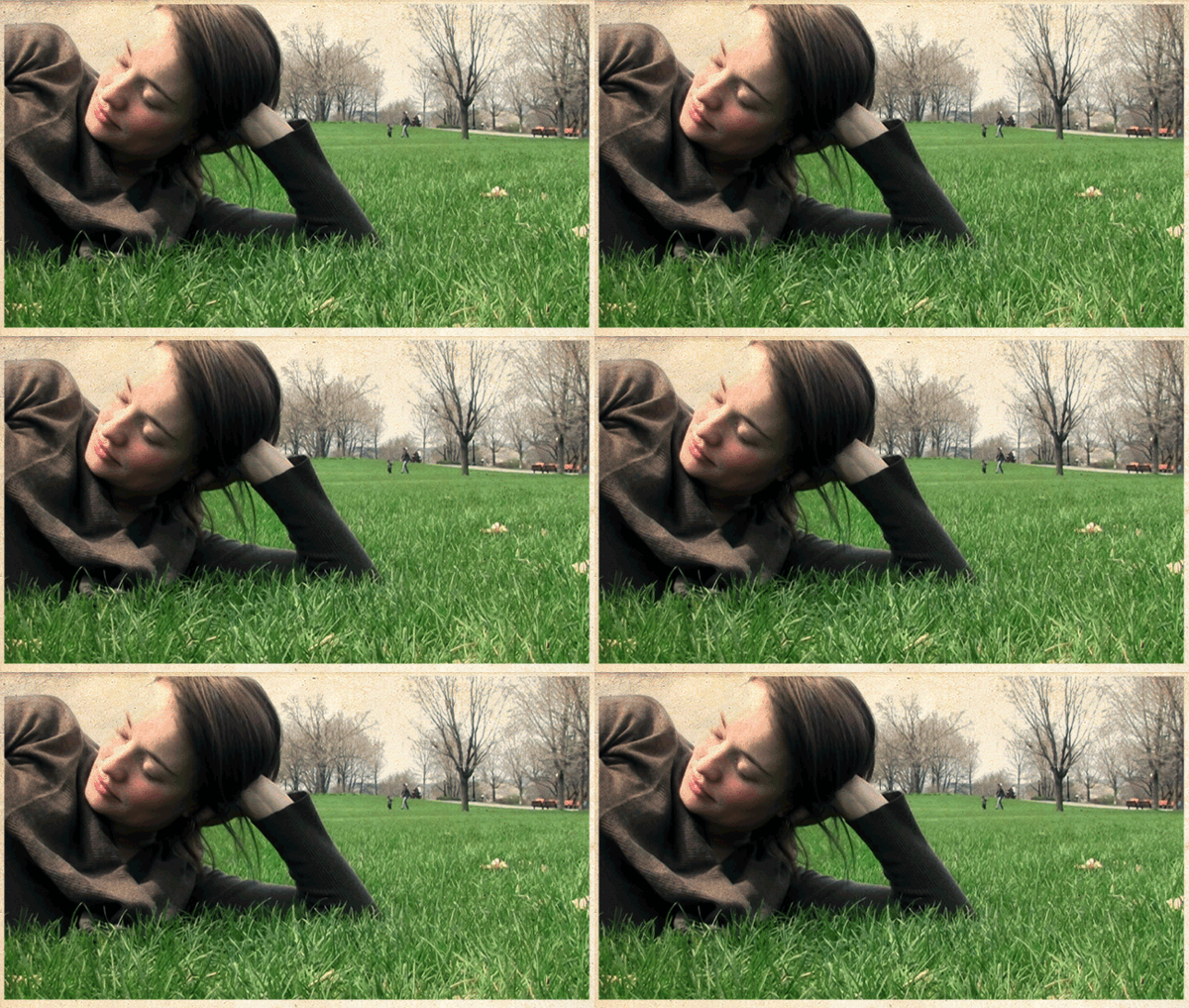
| The Cinemagraph e How I Made a Cinemagraph di Christopher Mathew Burt Il tutorial è stato tradotto in italiano dal sito Espressioni digitali: Cinemagraph: vi spieghiamo come si realizza |
 |
| Cinemagraph/Subtle GIF Tutorial di anthonyScavarelli |
 |
| How To Make Your Own Cinemagraphs: A New Take on GIFs di Matt Braga |


 |
| Coco Rocha è una delle modelle che ha collaborato con Jaime Beck e Kevin Burg, vedi il suo sito Oh so Coco |
Turnstyle: Animated .gifs have long been the territory of goofy forum signatures and internet memes, what caused you to take the idea of animated photographs up to the level of art?
Jamie & Kevin: We wanted to tell more of a story than a single still frame photograph, but didn't want the high maintenance aspect of a video. In preparation for Fashion Week we were trying to figure out a way to show more about what it was like being there, so cinemagraphs were born out of a need to tell a story in a fast digital age.
The basis for these is always a still photograph which is why they maintain the artistic approach and visual style of Jamie's still photography. What we strive to capture is the moments before and after a photograph is taken.
TS: Why "cinemagraph"?
J&K: There's a cinematic quality to them in both the way it captures a moment as well as the coming together of still imagery and moving imagery. "Cinemagraph" represents, in a single word, what the images represent visually. Coco Rocha put it well: "More than a photo, but not quite a video."TS: Technically speaking, how are these different from animated .gifs? I'm perceiving a lot more frames of animation for one, but is that just my brain filling in the blanks? It also feels like the animated parts are isolated from the rest of the composition.J&K: An animated .gif is usually a sequence of stills pulled from video, animated art, or other imagery that is repurposed into a .gif. What we do is different because it's a traditional still photograph with a moment living within it. For us it's less about the .gif format -- that's just the vessel by which it's best to deliver them on the web, although the limitations of the format have been very influential on the visual style of our images. The .gif format itself is ancient by internet standards but much like photography people are always finding interesting new ways to communicate within the confines of existing formats.TS: How long did it take you to develop the technique?J&K: Kevin has a background in motion graphics and has been playing with the .gif format since getting a computer in the mid 90s, but this particular technique started taking shape about a year and a half ago. It was the coming together of Jamie's photography and this technique that made it what it is currently.TS: How do you choose a subject for a cinemagraph?J&K: A cinemagraph always starts with a photograph. As a rule of thumb, we only create a cinemagraph from subject matter that would also make a good still photo. Often times we'll have an idea for a cinemagraph that captures the essence of the subject through an action or moment in a way that a photograph can't. When we decide to take a still photograph, and make it into a cinemagraph, it's when there's more to the story than can be captured in a still frame. We really feel this is an opportunity to look at everything we know in the world and show it in a new way, which is an extraordinary opportunity as artist and visual creators.

